
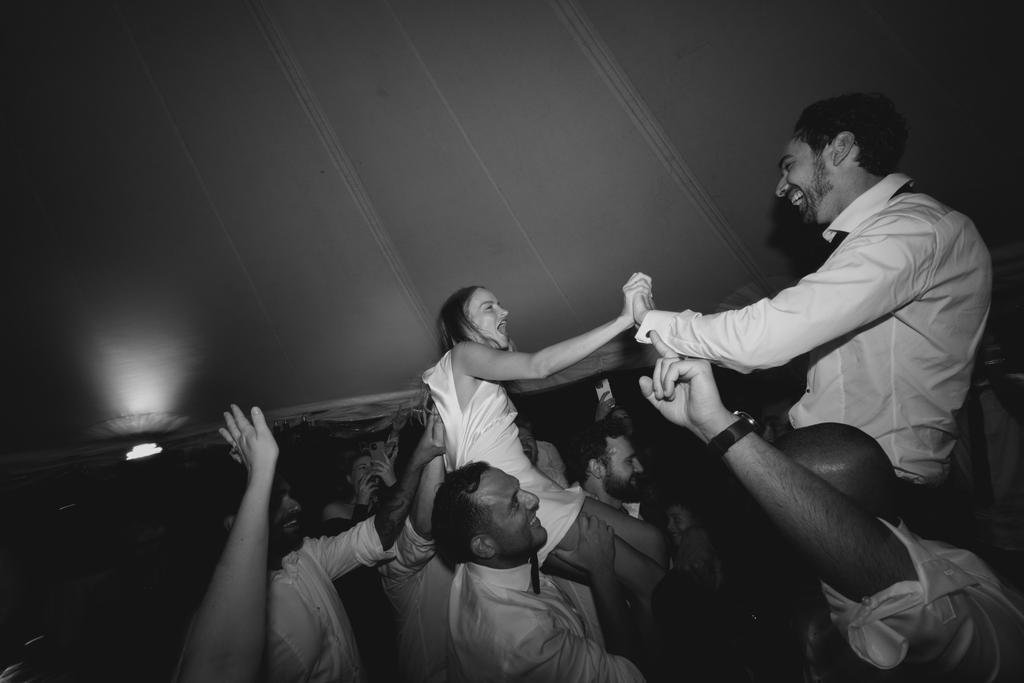
Couples often choose a wedding venue based on the ceremony backdrop, the dining room and how it will look in photos. All fair enough. But if you want the reception to finish with a genuinely packed dance floor, there is another question worth asking before you book:
Will this venue actually help the party happen?
At Northern Beaches DJs, we have played at hundreds of wedding venues across Sydney. We have seen stunning rooms turn into incredible parties, and equally beautiful spaces quietly drain the energy from the dance floor.
A great DJ can read the room, choose the right music and build momentum, but the layout and restrictions of the venue still matter. Here is what to check before signing a contract.
Ask About Noise Limits and Music Curfews
Do not assume that the venue’s closing time is also the time the music can continue until.
A venue might allow guests to stay until midnight but require amplified music to finish at 10:30pm. Others have strict decibel limits, sound-monitoring equipment or rules requiring doors and windows to stay closed.
Ask the venue:
What time can amplified music continue until?
Is there a decibel limit?
Does the volume need to be reduced later in the evening?
Are subwoofers allowed?
Is there a sound limiter that cuts the power if music becomes too loud?
Noise restrictions do not automatically make a venue unsuitable. They simply need to match the kind of wedding you are planning. Finding out three weeks before the wedding that the dance music must finish early is not ideal.
Look at Where the Dance Floor Sits
The best dance floors feel like the centre of the reception, not a separate room guests need to discover.
Ideally, the dance floor should be visible from the tables, close to the DJ and easy to reach once dinner and speeches finish. Guests are much more likely to join in when they can see other people dancing and feel that the party is happening around them.
Be cautious if the dance floor is:
Hidden around a corner
In a separate room
At the opposite end of a very long space
Blocked by tables or furniture
Disconnected from the DJ and speakers
A beautiful dance floor is not much use if half the guests forget it is there.
Check the Distance to the Bar
The relationship between the bar and dance floor makes a surprisingly big difference.
If guests need to leave the room, walk downstairs or cross the venue every time they want a drink, the crowd can quickly split into two groups: people dancing and people standing near the bar.
The bar does not need to be directly beside the speakers, but guests should still feel connected to the music while ordering a drink.
During your venue inspection, physically walk from the proposed dance floor to the bar. If it feels like leaving the party, it probably will on the night too.
Consider the Room Shape and Size
Bigger is not always better.
A huge ballroom can look impressive when empty, but a small guest list spread across an oversized room can make the dance floor feel exposed. A slightly more compact space often creates better energy because everyone feels closer together.
Long rooms, L-shaped spaces, pillars and dividing walls can also affect how well guests see the dance floor and how evenly the music travels.
Ask whether tables can be moved after dinner to create a more intimate party area. Sometimes a small change to the floor plan makes an enormous difference.
Pay Attention to Ceiling Height and Acoustics
High ceilings, large glass walls, concrete floors and hard surfaces can all affect how music sounds.
Some rooms create echo. Others allow sound to disappear upwards, meaning the music feels loud near the speakers but weak elsewhere.
An experienced DJ can adapt the setup, but it helps to know what we are working with. Ask whether the venue regularly hosts DJs, where speakers are normally positioned and whether the in-house sound system is suitable for dancing.
Some built-in systems are excellent for speeches and background music but lack the power and bass needed for a lively dance floor.
Confirm the Power Supply
Power is not the most exciting part of wedding planning, but it is essential.
The DJ, lighting, photo booth, band and other suppliers may all need access to electricity. Problems arise when everyone is expected to use the same outlet or when the nearest power point is on the other side of the room.
Ask whether there is dedicated power near the DJ position and whether separate circuits are available for entertainment equipment.
For outdoor receptions, confirm that power is weather-protected and that there is a backup plan if conditions change.
Ask About DJ Position and Load-In Access
The DJ should be close enough to see the dance floor and read the crowd. Putting the DJ behind a wall, on a balcony or in another room makes it harder to respond to guests and build momentum.
You should also ask how suppliers bring equipment into the venue.
Is there a loading zone? Are there stairs? Is the lift large enough for speakers and lighting? How far is the reception room from the parking area? What time can suppliers access the space?
Difficult access does not make a venue impossible, but it can affect setup time, staffing and equipment choices.
Inspect the Venue With the Party in Mind
When visiting a venue, do not only imagine the ceremony and dinner. Picture the room at 9:30pm.
Where are the guests standing? Can they see the dance floor? Is the bar nearby? Can the DJ see the crowd? Will the music need to be turned down just as the party gets going?
Couples still comparing locations can browse wedding venues in NSW using Ever After Weddings directory and shortlist spaces that suit both the daytime celebration and the party afterwards.
A packed dance floor is never created by the venue alone. The guests, music, timing and atmosphere all play a part. But when the room is well laid out, the sound works and the dance floor feels like the natural heart of the reception, everything becomes much easier.
Choose a venue that works with the party, not against it.